The University Front: Analysis of the US Student Movement

Base and Superstructure
The wave of U.S. student mobilizations for Palestine represents a sharp development in the class struggle within the imperial core. However, I believe there are many incorrect conclusions and idealist conceptions bouncing around the proverbial room. To understand this movement's character and potential, we must analyze it not as a simple moment of spontaneous confrontation, but as a concerted political struggle that exposes the fundamental nature of class relations, capitalist institutions, and the state power that protects them.
At its core, the movement's primary demand - university divestment from Israel and the war industry at-large - is a direct attack on the financial architecture of imperialism. The modern bourgeois university, particularly the large endowment-funded institution, is not a sanctuary of abstract learning. It is a major, centralized node of finance capital with its investments deeply integrated into the entire global capitalist system. Its endowment portfolios are linked directly to arms manufacturers, technology firms supplying military applications and developments, and countless other corporations central to the project of imperialist domination.
The strategic usefulness of the divestment demand lies in its ability to force this reality into the open, to remove the curtain entirely and reveal the whole picture. By demanding full financial transparency, the movement seeks to strip away the liberal-humanist veneer of the institution of bourgeois university and reveal its true function as a capital accumulator and a silent partner in the extraction of super-profits from the colonized world. The struggle is not merely over a financial portfolio; it is a struggle to sever the material ties that bind a key ideological institution to a functioning genocidal, imperialist project. The demand for divestment is, in essence, a demand for the university to cease being an apparatus of imperialist finance.
The movement's other key demands reveal a parallel struggle within the superstructure, in the realms of law, governance, and ideology. When student activists are met not with dialogue but instead with suspensions, police citations, and legal harassment, they receive a practical, lived education in the Leninist theory of the state. The university administration, alongside campus and municipal police, act as a manager and enforcer for the bourgeois order. Their purpose is to safeguard property relations and suppress any threat to the ideological and economic status quo. The movement's demand for amnesty is therefore not a reactive plea for mercy, nor simply a defensive political struggle, but an offensive struggle against this existing repression, a political struggle necessary for its own survival and growth.
Historical Trajectory and Strategic Imperatives
This movement exists within a specific and particular historical lineage of student-youth vanguardism, or rather, within the context of the development of a class-conscious youth, from the opposition to the Vietnam War to the struggle against South African apartheid.
Students, particularly university students, drawn largely from the petty bourgeoisie and the working-class intelligentsia, often achieve a high level of political consciousness before their rural or industrial working-class peers, due in large part to their relative freedom to engage in study and leisure as well as their social position within the ideological apparatus of the university itself.
However, the movement's ultimate historical impact hinges on its ability to transcend this particular role.
Its most critical strategic task is to forge a concrete, operational alliance with the organized working class. The power of the student intelligentsia and that of the industrial proletariat are qualitatively different, and the fusion of these forces is the only combination capable of mounting a serious challenge to the bourgeois state.
The student movement possesses the unique power to disrupt the ideological reproduction of capitalism. However, this power has inherent limits. Student strikes do not, in themselves, halt the production of surplus value. They disrupt the training of the managers of capital, but not the immediate extraction of capital. The bourgeoisie can, for a time, tolerate campus unrest. It cannot tolerate any sustained interruption of production, logistics, and circulation. When student power reaches its peak, the state's response is ultimately containment and repression.
The students, lacking the base social power that comes from a strategic position in the economy, cannot by themselves force any fundamental concession.
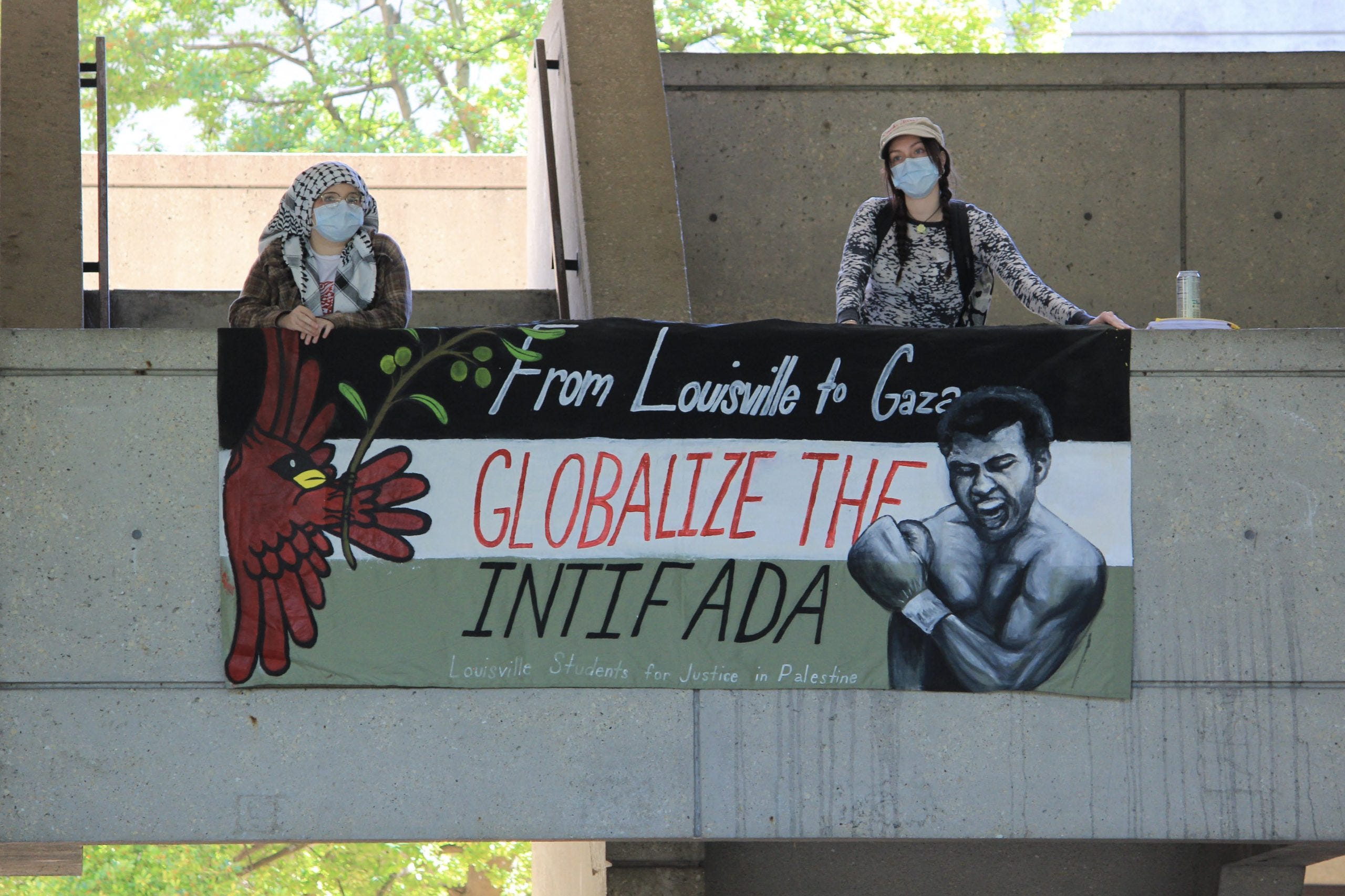
The LSJP call to "democratize" the University of Louisville by abolishing its board of trustees, for instance, is one such profoundly radical demand. The typical university board is a crystallized form of bourgeois class power: an unelected committee of corporate executives, financiers, and loyal state functionaries that ensure the institution serves capitalist interests. To demand its abolition is to challenge the very principle of unelected, capitalist control over social life. While the full realization of this demand is impossible without the realization of social revolution, its articulation in this moment is, nonetheless, correct.
Why is this?
First, we must be scientifically clear about why this demand is impossible within the confines of the bourgeois state.
The bourgeois university is not an independent entity. It is an Ideological State Apparatus, one of the primary institutions (alongside the media, church, family) through which the ruling class reproduces its ideology and ensures the ideological submission of the masses to the established social order. Its function is to produce a workforce with the necessary technical skills and, more importantly, a worldview that accepts the legitimacy of capitalist social relations.
This unelected Board of Trustees is the direct mechanism of class control over this ISA. It is a microcosm of capitalist class relation itself, composed of financiers, corporate CEOs, and retired state officials. Their mandate is not to serve the community, but to ensure the university apparatus fulfills it's necessary economic function for capital. They safeguard the endowment (a massive concentration of capital), direct research towards commercially viable or militarily useful ends, and ensure the curriculum does not systematically challenge bourgeois hegemony. To expect this body to dissolve itself and cede power to students, faculty, and staff - the very constituents whose consciousness it is meant to manage - is similar to expecting the bourgeoisie to vote itself out of existence. It would be a fundamental error.
Should a university administration ever be pressured to the point of conceding to such a demand, the broader bourgeois state would then immediately intervene. State legislatures would cut funding, accrediting bodies would decertify the institution, and the legal apparatus would rule any other move illegal. The repressive state apparatus (the police, courts, etc) ultimately stand behind the ideological ones.
Given this, why is raising such a demand not adventurist or ultra-leftist? Because its value lies not in its immediate achievability, but in its actual function within the overall process of class struggle. It is correct because it actively shapes and develops the consciousness of the participants in a specific, revolutionary direction.
Liberal politics is predicated on the illusion that the system is already fundamentally democratic and that any shortcomings can be reformed out of existence through its own channels. The struggle for a "democratic university," within a “democracy,” shatters this illusion. When students and workers organize, collect petitions and signatures, pass resolutions, win support of the masses, and yet are still met with an intractable, unelected board of hostile moneyed interests, they learn a visceral but valuable lesson. They see that bourgeois “democracy” really is nothing more than a form of brutal class dictatorship. The "freedom" offered is the freedom to choose which manager of the capitalist system will preside, not the freedom to challenge or change the system itself. This practical experience is infinitely more powerful than any theoretical pamphlet or exposition. It transforms an abstract understanding of the state into a concrete and lived one.
Therefore, the demand to "democratize the university" is not a blueprint for an unachievable reform nor an ultra-leftist deviation from organized struggle. It is a strategic pivot around which the entire struggle can be elevated. Its ultimate success as an agitational demand is not measured by whether or not the Board of Trustees is abolished tomorrow (a near-certain impossibility) but by whether the struggle to achieve such a demand raises the political consciousness and organizational capacity of the masses and clarifies the political landscape at large.
The Unity of Form and Content
From this, we can see that the struggle to democratize the university and the fight to build a worker-student alliance represent the inseparable unity of the political form and the social force required for a revolutionary change. The democratic demand creates the organizational embryo of a new power, while the class alliance provides the historical agent capable of bringing such power to life.
The call to institute popular control, while politically sharp, remains an abstract and ultimately unrealizable demand if it is confined to the campus community alone. Even if successful, when considered in isolation, it risks becoming a form of petty-bourgeois radicalism that lacks a concrete working-class foundation. A university run solely by students and faculty, without the structured participation of the industrial working class, would remain an institution dominated by the petty bourgeoisie and the technical intelligentsia. Its class perspective would be inherently limited. Such a form might challenge the most blatant forms of imperialist investment, but would it reorient the entire curriculum and research agenda to serve the needs of the working class and oppressed peoples of the world? Would it actively work to dissolve the boundary between "the academy" and "the industrial shop floor?” Would it transform itself into a center for rural and industrial workers' education and the development of technology and social infrastructure for collective need, not profit-margins or idealist theory-chasing? History suggests that without the guiding force of the proletarian class, such experiments tend to drift or become reabsorbed into the capitalist system entirely.
Conversely, a purely economic alliance, focused only on immediate solidarity actions, lacks a transformative political horizon. It can then become a tactical partnership without a strategic goal which ultimately wanders into aimlessness, or worse, fragmentation. The demand for democratization provides that concrete goal; it gives the alliance a common project that transcends any single issue and resists derailment.
The organized working class is the only social force with the power to make these demands a reality. A city-wide general strike in support of the students' occupation is a qualitatively different threat than a student-campus occupation alone. It raises the stakes from a campus dispute to a direct challenge to the economic stability of the entire ruling class. When longshoremen and dock workers refuse to unload cargo until the students are granted amnesty and the Board is dissolved, the abstract demand for democratization gains a material force that the state cannot ignore.
The workers’ movement provides the shield without which the student movement cannot survive.
In such a synthesis, the struggle on campus becomes inextricably linked to the struggle in the factory. The demand to divest from Israel is understood as part of the demand to disinvest from capital and reinvest in the working class as a whole. This is the process by which a protest against imperialist atrocity matures into a long-term struggle for socialism, forging a centrally organized popular bloc of the masses capable of challenging not just a board of trustees, but the dictatorship of the bourgeoisie itself.
Conclusion
We can now see how the student movement for Palestine, in its most advanced expressions, represents a significant qualitative leap in political consciousness. However, this analysis remains incomplete, and the movement remains critically vulnerable, without a conscious and strategic pivot toward its necessary historical agent: the organized industrial proletariat.
The great but limited power of the student vanguard to disrupt the ideological reproduction of capitalism must be fused with the unique power of the working class to paralyze its material reproduction.
Therefore, the ultimate historical significance of this movement will not be determined by the number of encampments erected or defended, or the specific disclosures won from any number of administrations. Its success will be measured by its ability to transform itself from a student protest into a nucleus of a broader popular power bloc. This requires the deliberate and disciplined work of building durable, functioning links with the organized working class, articulating a shared analysis that connects the genocide in Gaza to the class war at home, and moving toward coordinated joint actions and campaigns.
The struggle on the occupied quad must become inextricably linked to the struggle at the factory gate.